All articles
On the Job: Diane Batayeh, CEO, Village Green
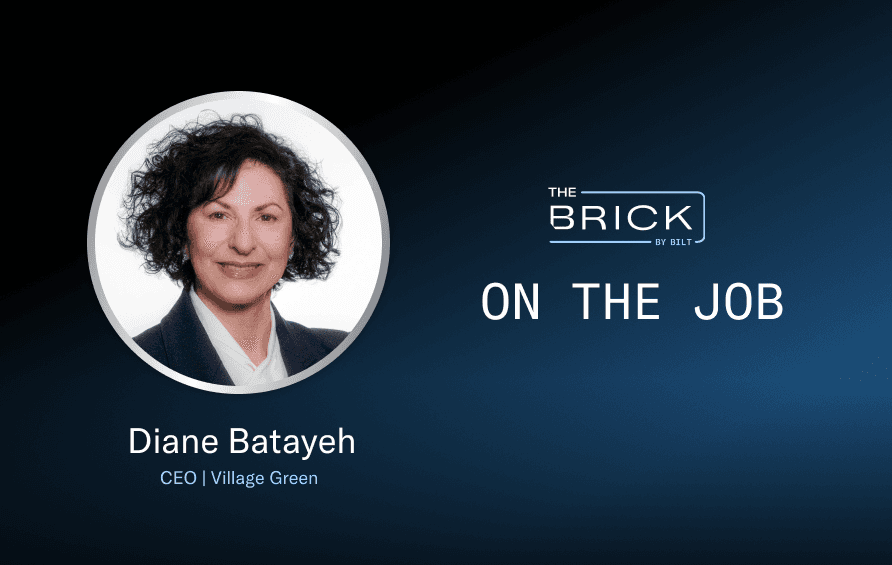
Forty six years before leading Village Green as CEO, Diane Batayeh was on a path to law school. She planned to work in government, driven by her desire to make people’s lives better after experiencing firsthand the struggles of underprivileged families in her hometown of Detroit.
To support herself in college, she took on a leasing agent job at the Village Green property where she lived. At the time, she had no idea that it would be the start of a long career in an industry outside what she was originally planning for her life, but she came to realize that at Village Green, she could make an even greater difference in communities: a belief that continues to shape how she leads today.
Check out Diane's interview below, and subscribe to The Brick for more profiles on housing leaders — including their paths and advice for the next generation.
Getting in on the Ground Floor
How would you describe the path you took to get where you are today? What lateral moves, skill-building moments, or strategic pivots shaped your journey, and why?
My path was like a winding road that meandered uphill, with twists and turns I could not have anticipated would lead to my current spot at the helm of Village Green. The journey is best described as the culmination of saying yes when asked to do things and getting comfortable being uncomfortable.
I began working as a part time leasing agent at Village Green simply to support myself while in college. I accepted a promotion to an Assistant Property Manager and within one year, I was promoted to Property Manager. The second-generation owners were engaged with all levels of employees, and I was fortunate to be selected to take on special projects that involved preparing investment packages.
I was in my early twenties with no experience on the investment side, but I was ambitious and open to the challenge. I became a one-man operation, opening the company’s satellite office in Denver and wearing multiple hats. The skills I acquired during that time included things like land and asset acquisitions, market research, development/entitlements, and financing. I’m grateful for it and the mentorship I received and a time when there were very few females on that side of the multifamily industry. All the experiences during those early years shaped me and helped me build a strong knowledge base for when I ultimately ascended to the Chief Investment Officer position.
Becoming the CIO was not an intentional goal I set for myself. Saying “yes” to an opportunity to show my creative writing, marketing, and communication skills when as a property manager I was asked to help prepare an investment package is what put me on that trajectory. I spent the majority of the next three decades on the investment and capital markets side of the business, going from operating a satellite office in Denver to becoming a VP of Development, and then elevating to an EVP title which preceded the CIO position.
In 2011, I was asked to take on the COO position. I had to gain the trust of a well-established and successful team, get their buy-in as well as their help educating me on what I didn’t already know, and most importantly, be willing to collaborate on the path forward. That was among the most challenging times in my career because leading highly successful senior leaders and proving I could bring them value was much more difficult than leading a team whose jobs I had done myself.
In 2016, after five years in the COO position, I was elevated to CEO when the final remaining family member of the company’s founders decided to sell his interests in the company.
The Building Process
What was one of the most challenging professional setbacks you faced…one that may have felt bad in the moment but ultimately taught you a lasting lesson? What did you learn, and how did it change you?
In the early days as a CEO, I was tasked with establishing a new culture, mission, and vision for the company and building an Executive Team of trusted individuals who would partner with me in executing those things. I felt the pressure to make changes and made decisions more rapidly than I should have. I chose people I felt were right at the time, putting them in positions of power and influence without doing the proper due diligence nor requiring some to earn the spot.
I had no idea at the time that one of those individuals would ultimately betray my and the team’s trust by working behind the scenes to undermine efforts, create disruption and chaos, and cause another individual of great value to leave the company. The company stagnated and I was close to having my entire career upended.
Fortunately, I was able to course-correct, but not without losing valuable people and time. I had to make decisions to restore confidence and trust. That experience was difficult, but I learned that having a team of “A” players is not nearly as important as ensuring the team you build is an “A-level” team holistically, with mutual respect, trust, and confidence in one another.
As their leader, it’s incumbent on me to ensure they feel good about the person sitting at the table with them and recognize each other’s value proposition. Together we are better than any one individual alone.
To that end, each year at our annual review cycle, I conduct 360 due diligence that includes all Executive team members and myself to ensure no blind spots and that everyone is held to the same standard. We are responsible for taking care of every stakeholder we serve, including our onsite and regional teams, our owners, our residents, our business partners and each other.
What was one of your biggest professional wins or breakout opportunities? What did it teach you, and how did it shape your trajectory?
When I was a young developer, I was given the reins to run point on the entitlement efforts for a controversial new development that caused an upheaval and brought out the NIMBY protestors.
That was among the most intimidating experiences where my newly cultivated acting skills were truly tested. I made my way up to the podium on visibly shaking legs, with presentation boards and easel in tow, fumbled my way through setting everything up, and then proceeded to make the case for why it was one of the most beneficial developments for the neighborhood. Miraculously, I made it through the presentation and when I returned to my seat, my boss, who was our company owner, complimented me. I was surprised by that since I didn’t feel confident that I had done well. We got the approvals we needed to proceed so that was a high-five moment.
It taught me that I need to have more self-confidence and that I was the only thing in the way of my future. I learned that I should not limit nor define myself by what I may currently be good at doing or what I see myself capable of based upon my past experiences. Those things don’t define my future but instead are part of my foundation. My future was shaped by what I was willing to do and how hard I pushed myself past where I’d already been.
What You’re Building Today
What does your role look like today? Walk us through what you oversee, the impact you aim to have, and how your day-to-day responsibilities reflect the skills you’ve built over time.
I’m the CEO of Village Green Holding which is the parent company of apartment and commercial property management companies, and a digital marketing, advertising and interior design firm called GREENWORKS Studio. In my role, I oversee all operating companies and am responsible for charting strategic direction and ensuring their ongoing growth and evolution to benefit all stakeholders. My career enables me to have true empathy for all stakeholders and build the business in a manner that effectively serves their needs.
I measure my effectiveness by how well others are being served. The impact I strive for is to make people’s lives better, like creating homes where people feel comfortable and valued, creating growth opportunities for our people and our client-owners, giving back in our communities through our philanthropic arm (VGives), and proliferating the company’s legacy vision and mission of taking care of people in their homes and at their jobs.
I strive to proliferate a company culture that is centered on “People First”. We are in the people business, and to be the best, you must attract and retain the best talent.
Leadership Structures
How would you describe your leadership style today, and how has it evolved throughout your career?
My style of leadership is “relational” as opposed to “positional” which is centered on building genuine relationships grounded in and service. I lead based on the inverted pyramid model where I’m at the bottom and our onsite people are at the top. They are front facing and need to have an infrastructure that serves them and gives them all the support and resources they need to deliver exceptional customer service. That, in turn, drives the highest level of performance for our client-owners.
Blueprints for Future Operators
What advice would you give to rising operators in real estate who want to advance into senior roles?
The best advice I could give is to put your people first. Focus on mentoring and empowering your team to be successful because your ability to rise will depend upon effective succession planning and execution.
To become non-essential when leading your team enables you to move up the ladder. Embrace the concept that you’re only as good as your team’s weakest link and work to strengthen and create a consistently successful team. Also, don’t be afraid to make mistakes and learn from them. It’s those who repeat the same mistakes without learning and applying those lessons to get better that will likely remain stagnant.
People who push themselves outside their comfort zones, learn from and take accountability for mistakes or failures, and give credit to their teams for successes are the ones that rise to higher levels with their loyal teams creating the rising tides that lift them all up.
+++
Want more insights from housing leaders? Subscribe to The Brick.